
How Self-Referential Thinking Limits What We Can Understand
This article presents a layered map of perception, showing how the same idea is understood differently depending on the frame through which it's read.


One could be intelligent, perceptive, sensitive, or introspective without necessarily escaping the unfortunate limitation of having one’s insight constrained by one’s own perception.
This implies that he or she holds an ideology in seeing reality in its true essence, but the truth is that he or she sees reality through the reductionist lens and/or perceptual frame of biography, suffering, values, fear, identity, thought process, culture, membership, ethics, and preferred explanation. Everything is seen through a particular perceptual frame. In terms of subjectivity, each person tends to feel that their own view is right, and that they are discerning, intuitive, realistic, smart, and perceptive enough to see things clearly. The more sophisticated the person is, the more believable his or her perception becomes.
This is not an easy topic to write on since this very paradox is found in attempting to explain perception itself. As soon as one sets oneself to articulate the range of perspectives that can be had, one will have to find the most effective means for doing so.
This was apparent to me as I struggled to write this article. Thought became recursive; while I wrote about perceptual limitations, I encountered my own perceptual limitations. While discussing reduction, I reduced complexity into structure and symbol; while I discussed infinite perspectives, I became aware of my finite perspectives.
Something close to absurd humor became evident to me in the process of writing. On the one hand, I was trying to encourage others toward more open-mindedness; on the other, I was confronted by the limits of my own perspective, unable to articulate the many frames and complexities that kept unfolding as I wrote.
So why should you keep reading this? Because when someone learns to examine their own ways of thinking and perceiving, while becoming willing to learn through perspectives beyond their own, they gain access to a more vast, beautiful, inclusive, and intelligible view of reality.
This process allows people to begin to understand other people, conflict, ideas, theories, and systems with more precision and nuance.
A lot of people only read what dignifies their own cognitive processes or their own wounds. And I mean, it makes sense that we use our own self-referential systems of experience to learn because without some point of contact within the self, information can feel triggering, random, disconnected, and irrelevant. The self helps us feel where the idea,experience or object sits in relation to our own experience. It tells us why something matters, where to place it, whether to remember it, whether to care. Our wounds and thought processes create a certain perception, sensitivity, pattern-recognition, vigilance, hunger, and sometimes even extraordinary depth. However, we can become highly developed within a single way of thinking or being, fluent in the language of our own injury, our own condition, our own group, or our own misunderstoodness.
What I wonder is why people so often stop following a thread of thought once it no longer confirms their own reality. Do we continue to think when thought leads beyond the terms through which we understand ourselves? Do we pursue what is real, or simply gather information that confirms the way we already understand ourselves and the world? and by “real”, I mean reality beyond the limits of personal perception, internal narrative, group confirmation, and ordinary material “scientific” apprehension, including dimensions of existence that may not be reducible to the physical plane.
To be clear, I think self-reference obviously has a purpose. I have had to process my own journey, understand my own cognition, my own defences, my own emotions, and give them some kind of self-definition before I could begin to see the outside world as something distinct from my own internal experience. I don’t think learning and focusing on myself has been the problem per se. For me, it has been necessary. Without that inner differentiation, I would be less able to see where perception, inference, fear, intuition, projection, and actual discernment blur into one another or where my own inner world has quietly been blending into the outer world without me noticing.
If we have not developed enough self-awareness, our own subjective experience can begin to interfere with how we understand a perception, concept, or idea. We read a sentence, hear someone speak, or encounter a new perspective, and our mind immediately filters it through our history, wounds, fears, defences, longings, and preferred explanations. We may then think we are understanding what was said, when we are actually reacting to what it reminds us of. We may think something is true because it feels familiar. We may think something is wrong because it threatens our self-concept. We may dismiss something as irrelevant simply because its connection to our own experience is not immediately obvious.
Only when we can begin to separate perception from projection, intuition from fear, and discernment from self-confirmation can we follow an idea beyond our personal identification with it and begin to see what it reveals about mind as such, beyond our own psychology — culture, reality, development, language, perception, systems, or truth.
My intention for writing this is to help you develop a larger mental world: one that can become interested in realities, structures, minds, systems, histories, and forms of existence that you haven’t even thought about being open to yet.
A developed mind does not limit its questions of relevance to oneself alone, but it rotates the object through a variety of different perspectives: causally, historically, psychologically, symbolically, strategically, ecologically, ethically, aesthetically, systemically, and institutionally.
What I see is only ever a fragment — but perhaps that fragmentary quality is itself part of how reality appears through perception, for any mind. To borrow a phrase from my teacher, at the risk of committing the sin of oversimplification, what follows is an attempt to describe this more directly.
Attention-Dependent Dimensional Stratification
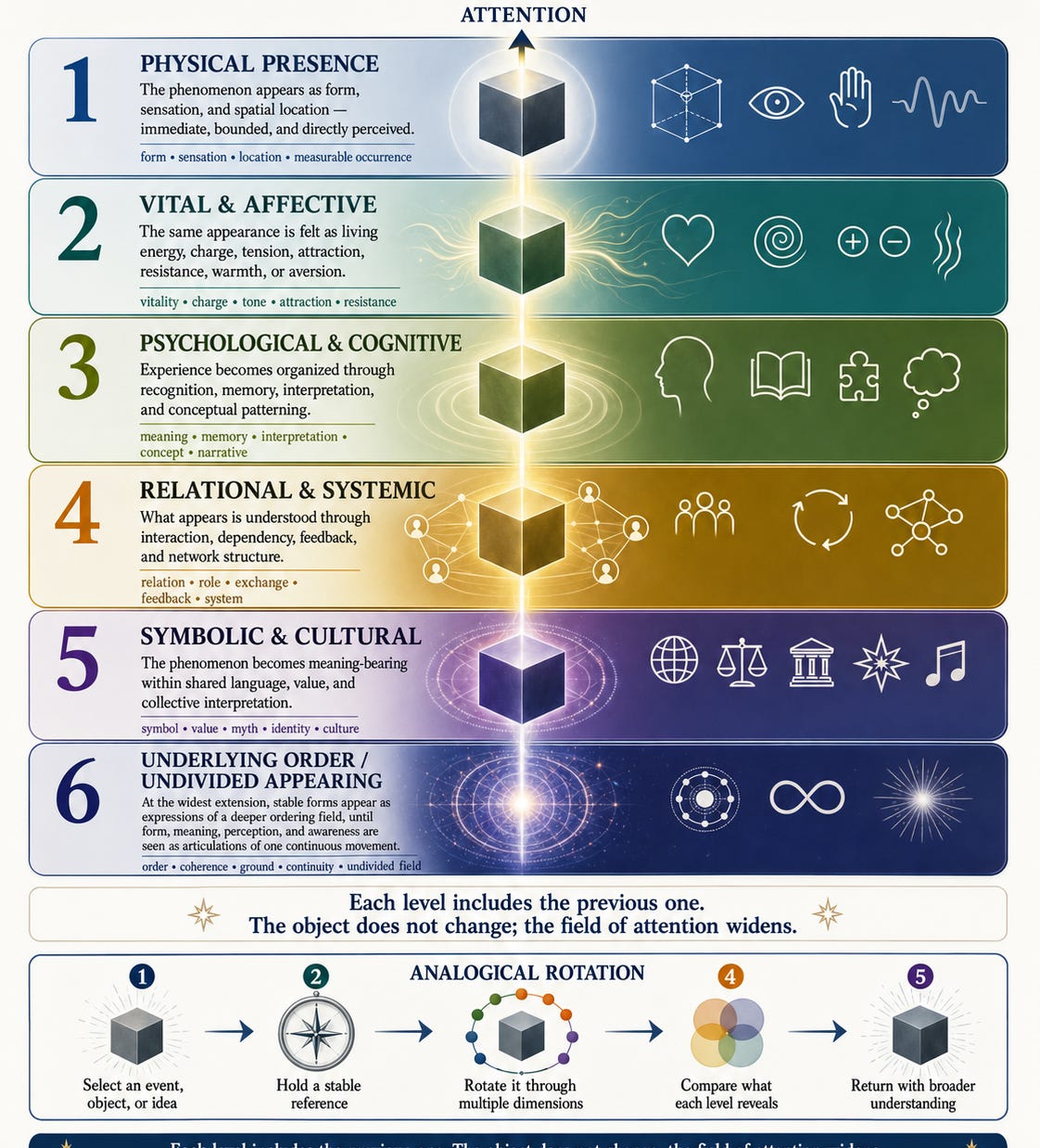
Attention-Dependent Dimensional Stratification refers to the way an idea, location, or object can show different layers depending on how attention is applied to it. The same thing remains the point of reference, but different kinds of attention bring out different dimensions of it: physical, emotional, symbolic, social, practical, relational, or conceptual. Stratification simply means that the thing is not being understood on one flat level. It is being understood through layers, while still remaining connected to the same original referent.
Analogical rotation refers to a method for widening the mind by taking one event, idea, or object and turning it through different structures of meaning. Instead of staying with one interpretation, the mind asks how the same thing changes when understood through another frame. For example, an event could be approached as a personal experience, a social pattern, a symbolic scene, a system, a memory, or a lesson. The event remains the reference point, but each rotation reveals another layer of it.
Any object of experience — whether a person, place, thing, or idea — is not experienced on a single level. What appears as a stable “thing” is better understood as a point where multiple aspects of experience are simultaneously present within awareness. It does not exist as a single fixed form, but arises through the convergence of these aspects in the act of being held in attention.
At the most immediate level, there is physical presence — the dimension in which something appears as form, sensation, and spatial location. In this mode, the object is encountered as if it were simply “there,” bounded and directly available to perception, as a body, a sound, a material thing, or a measurable occurrence. This is the most compressed form in which experience holds it, where complexity is temporarily collapsed into immediacy.
When attention is no longer restricted to physical presence alone, other aspects of the same phenomenon begin to come into view. Alongside form, sensation, and spatial location, the same appearance is encountered at a level where it is no longer held in mind as fixed, but as substance moving within a living field of experience. At one layer this appears as a subtle pulsing of vitality — a sense of life flowing through and sustaining what appears in the physical world, as though form is continuously animated from within its own presence. At another layer it is registered as tension, charge, attraction, resistance, warmth, or aversion.
As attention shifts into a more subtle mode of engagement, experience becomes organized through psychological and cognitive dimensions. In this stage, what is encountered is no longer only what is sensed or felt, but what is recognized, interpreted, remembered, and integrated into patterns of understanding. At this level, unlike a material object, which exists apart from its appearing, what appears here is formed into meaning by the very perception, categorization, memory, and conceptual activity through which the mind encounters it.
As attention extends further again, what is encountered can no longer be accounted for by its appearance to a single mind or isolated event; it becomes relational and systemic in character. Unlike psychic content, which is constituted through one mind’s perceiving, categorizing, and remembering, what appears here exists through interaction, dependency, feedback, and exchange across a network. What it is cannot be separated from the relations in which it participates, since its properties emerge through structure rather than through any isolated thing or any single act of perception.
At a further extension, what is encountered becomes symbolic and meaning-bearing, entering shared fields of language, value, and cultural interpretation. Unlike the relational object, whose properties emerge through structure and exchange, what appears here cannot be reduced to its material, psychological, or relational presence alone, because it is also defined by what it represents, what it signifies within collective systems of meaning, and how it is stabilized through shared recognition across a wider field of understanding.
At a yet further extension, what had appeared as symbolic and stabilized through shared recognition begins to suggest a dependence upon something more fundamental than symbolic meaning itself. Unlike the symbolic object, whose significance emerges through collective systems of interpretation and cultural recognition, what is encountered here cannot be reduced to meaning, representation, or shared understanding alone, because the very possibility of symbols, relations, psychic formations, and material objects alike seems to depend upon a more basic regularity through which stable forms arise and persist. What appears at this level is not another object, relation, or symbol, but the possibility of an underlying source of order itself: that through which appearances become coherent, repeatable, and capable of taking form across every preceding level. Yet because language, thought, and symbolic representation themselves arise within these more fundamental conditions, what is encountered here resists direct articulation and can only be approached indirectly through the forms in which it manifests.
At the most extended level still, even the distinction between appearances and their source begins to dissolve. What had been approached as an underlying basis of order is no longer encountered as something standing behind appearances, but as appearance itself, undivided. Form, perception, meaning, and awareness are no longer understood as distinct things held in relation, but as different articulations of the same continuous movement, viewed from different degrees of contraction—like distinct notes within a single unfolding piece of music, inseparable from the movement in which they appear. What remains is not a thing among other things, nor a field behind things, but the single activity through which phenomena arise, stabilize, and return into latency—the ground from which every prior level was already a partial articulation.
Taken together, this progression moves through six levels of constitution: from (1) the brute existence of the material object, which stands apart from its appearing; to (2) existence-for-a-mind, in which psychic content is formed through the very acts of perception and cognition that encounter it; to (3) existence-through-relation, in which the object’s properties emerge from its position within a network rather than from any isolated thing; to (4) existence-as-meaning-within-a-collective, in which the object enters shared symbolic and cultural fields of signification; to (5) existence as grounded in an underlying order, in which even symbolic meaning is seen to depend on a more basic regularity through which stable, repeatable forms arise at all; and finally to (6) existence as undivided appearing, at which form, perception, meaning, and awareness are no longer separable dimensions held together, but different articulations of a single field from which all the prior levels arise as more or less contracted modes of attention. Each level does not displace the one before it; rather, the progression traces a widening of the field within which the same appearance is held, until the boundary between object and awareness, which the earlier levels had only loosened, dissolves.
Self-Reference and the Emergence of Multiperspectival Intelligence

Self-reference is defined as the ability to perceive one’s own point of view as a factor in meaning creation. Multiperspectival intelligence is derived from such an awareness, for once an individual becomes aware of their own situated perspective, they are in a better position to recognize other perspectives as real interpretive positions rather than as distortions, errors, or threats. If something seems significant, beautiful, untrue, threatening, profound, or insignificant to us, we should understand that these meanings are already mediated by the point of view of the observer, which consists of history, desire, fear, language, morality, intellect, aesthetics, and identification issues.
The mind does not relate to all aspects of reality in the same way, with the same immediacy, vividness, or necessity. An idea, person, critique, experience, or signifier takes on significance, menace, beauty, insignificance, depth, practicality, through the filters that have already filtered the mind’s attention into the past, into desires, fears, values, memories, identities, cognitive patterns, and even the current situation itself. The problem is to distinguish why something is significant, urgent, or important before determining its worthiness – be it to oneself, others, the world.
For example, take the criticism:
“You’re being too sensitive.”
From self-reference, the criticism may be affectively relevant (emotionally relevant) because it hurts or irritates you. It may be defensively relevant (connected to self-protection) because it feels like your perception is being dismissed. It may be biographically relevant (connected to your personal history) because it touches a history of being minimised, misunderstood, or told that your reactions are too much. Finally, it can be developmentally relevant (related to developing capacity) in that it challenges whether your response is proportionate to the situation, or whether something old is intensifying what is happening now.
From the other person’s position, the criticism may be practically relevant (connected to action or consequence) because they do not know how to respond to the level of emotion in the exchange. It may be affectively relevant because they feel overwhelmed, blamed, or unable to speak freely. It may be epistemically relevant (connected to what can be known or understood) because they may genuinely believe the reaction is larger than the situation warrants.
From a relational position, the criticism may show a gap between impact and intention. One person may be trying to name hurt, while the other may be trying to defend against feeling accused. The relevance is not located only in one person’s sensitivity or the other person’s dismissal. Neither relevance lies solely within the sensitivity of one individual nor the denial of the other, but rather emerges in the interplay between two nervous systems, two pasts, two understandings, and two different expectations of the present.
From a wider contextual position, the criticism may also be culturally relevant (connected to shared norms, values, and social meanings). In some contexts, “too sensitive” is used to avoid accountability, emotional complexity, or harm. In another context, it may name a real difficulty with regulation, proportion, timing, or interpretation.
The same criticism may also be morally relevant if sensitivity is being used to dismiss real harm, or if emotional intensity is being used to control what another person is allowed to say. It may be symbolically relevant because “sensitivity” can stand for weakness, depth, attunement, fragility, manipulation, moral awareness, or lack of resilience, depending on the frame being used.
It may also be aesthetically relevant, not in terms of beauty, but in the way the interaction unfolds through tone, timing, intensity, pace, facial expression, silence, or the atmosphere between the two people. The same words mean something else entirely when spoken with tenderness, contempt, frustration, lightness, defensiveness, or sincerity. And it might be archetypally significant, cautiously, if this conversation replicates an old human dynamic: the feeling-carrier and the one afraid of drowning; the one who names the hurt and the other who sees it as an attack; the one who needs recognition and the other who maintains the distance. It might be practically significant if the next step is obvious: to ask for a definition of “too sensitive,” to separate emotion from reality, to acknowledge the effect without making the effect everything, or to slow the conversation down long enough to know what’s really happening.
So the criticism is not merely “true” or “false.” Relevance varies with position and manner. For the recipient, it might be affective, biographical, defensive, or developmental; for the speaker, practical, affective, avoidant, or epistemic. In their relationship, there might be a mismatch in terms of sensitivity; in the larger domain, a disparity between attunement and dysregulation. Higher relevance suggests that the thinker does not reduce the meanings to one judgment but makes sure to ascertain its nature first.
Psychic Permeability and the Discipline of Discernment
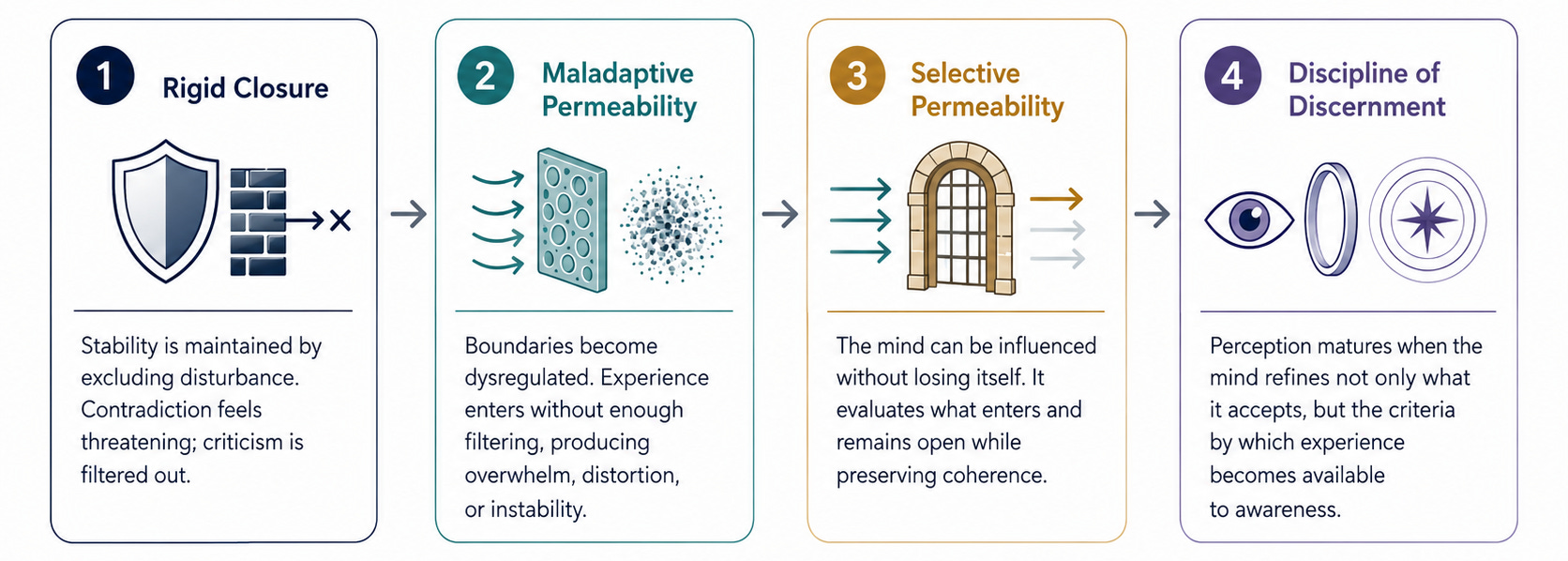
Something to keep in mind is that the organization of psychological permeability is influenced not just by temperament and developmental processes but also by experiences that surpass the psychological integration abilities of an individual’s psyche. Traumatic events can change how the mind manages its relationship with reality producing patterns of excessive exclusion, excessive receptivity, or distortions in the way experiences are interpreted and integrated. If an experience is considered so overwhelming, so threatening, or so disturbing to the psyche, then there is the possibility that one will adapt psychologically by organizing oneself according to the expectation of more disturbances, causing future encounters to be viewed through the influence of that expectation.
From this perspective, the danger in perception is not simply an excess of closure or openness. These represent only different expressions of a more fundamental disturbance in the regulation of psychological boundaries. What ultimately matters is not whether the mind is open or closed, but how it manages the conditions of contact between itself and reality.
One of the ways this may arise is as maladaptive permeability, which involves a dysfunctional boundary between the psyche and whatever attempts to enter into it. Our minds are constantly bombarded with “realities” from outside our own – whether it be someone’s point of view, criticism, environment, novel ideas, symbols, moral values, emotional appeals, or disturbing realities. Prior to any evaluation of these stimuli, our mind begins regulating its contact.
The mind that is closed and inflexible maintains itself through a lack of permeability. It achieves integrity by limiting what can enter into it. Contradiction is seen as pollution, criticism as aggression, ambiguity as a threat, and someone else’s world as a disturbance, rather than valuable input. This kind of mind may appear stable, rational, or self-possessed, but its stability depends on a constrained definition of reality. Such a mind is resistant to psychological maturation through its use of theory to protect its wholeness, rather than engaging in personal interaction to transform it.
A mind, which has become more sophisticated both cognitively and psychologically, possesses selective permeability. This means that it is capable of being influenced without losing its individuality in the process. As the level of development of the mind matures further, it becomes evident that selective permeability is not only the capacity to regulate external influences entering the mind, but also a consequence of the realization that the mind itself is a continuously changing entity, whose evolution is inseparable from the impact of diverse sources of information such as events, opinions, ideas, and experiences. Such a mind is always open to revising its own assumptions and categories of judgment.
Moreover, it recognizes that even when certain ideas appear fixed, separate, and clearly defined, this appearance is only temporary. Beneath this, they can be understood as momentary expressions of a continuous field of meaning in which forms arise into clarity, become stable enough to be thought, and then fade back into a less defined background of potential significance. Ideas are therefore not isolated units, but temporary formations within a continuous process of emergence and return.
From this perspective, perception is not limited to the evaluation of what appears as separate content, but extends to the medium through which those contents become available to awareness. What is being apprehended is not only what appears, but also the conditions that make appearance possible in the first place. In this way, the mind is able to refine the implicit criteria by which this ongoing flow is translated into cognition, perception, and consciousness.
Allocentric perspective-taking

Taking an allocentric perspective extends the scope of consciousness by transferring perceptual organization beyond the structure of one’s own mind and into that of another’s. This requires first the awareness that there may be other architectures of mind than one’s own. People do not simply hold different opinions inside the same perceptual world. Often they inhabit different systems of salience, evidence, threat, value, time, meaning, and reality-maintenance.
That is what makes allocentric perspective-taking more complex than mere empathy. While empathy poses the question of what emotions another person may have, that is essential but still limited by the framework of emotion itself. Allocentric perspective-taking questions the nature of experience itself in asking how exactly one’s consciousness is formed by some kind of expressive architecture. How is their attention, values, fears, speech, defense mechanisms, and way of action organized by some qualities inherent in them? This is less of an issue of feeling what the other feels than of understanding the architecture of how that experience transforms into perception, meaning, and expression for them. One person translates experience through will, another through love, another through intelligence, harmony, knowledge, devotion, or order. Each translation shows something with unique clarity.
In other words, two individuals might argue over a superficial point when they actually come from completely different architectures of reality. For instance, they may argue about a political policy, a personal relationship, a memory, a moral situation, or even just the interpretation of a sentence, when in fact, the difference between the two is much deeper in nature, residing in the nature of consciousness that they each bring to the table. One individual might have an agenda related to protecting his safety; another one’s mind might be concerned with freedom; yet another one might be defending his loyalty, integrity, or truth, for example. This dispute would therefore become only the tip of a bigger iceberg: beyond the explicit argument lay an entire pattern of attention that includes what the individual tends to pay attention to instinctively, defends without even being aware of it, uses as evidence, considers violation, and so on.
At such depths, however, attention must be non-possessive. This means that one delves deeply enough into another’s point of view to understand their utterances according to the perspective from within which they arise. A person never says what he or she says solely from a surface standpoint; rather, they say what they say from a certain meta-seeing arrangement — i.e., at a certain level of consciousness in terms of how reality is perceived and what kind of force is operating within their consciousness. What a person says indicates a plane of existence — i.e., the particular plane from which they are looking in terms of the level of consciousness they inhabit, the psychic values charged with significance by this experience, and their personal demons that protect and guard their very essence of being. To possess someone else’s point of view is to impose your meta-seeing arrangement on their own: making their defense your theory, their devotion your judgment, their wound your category and their difference your understanding. But non-possessive attention resists any such imposition.
Decoupling and Re-Integration

Decoupling and re-integration describe a cognitive process in which the mind temporarily loosens identification with its initial standpoint, examines through alternative frames of reference, and then incorporates what survives that testing into a revised standpoint. The aim is neither detachment from perspective nor endless perspectival relativism, but a more differentiated relation between the observer, the object, and the conditions through which the object is understood.
This means, however, that there are various ways by which perception may transcend the “little self.” In some cases, this happens because one of a person’s perceptual capacities is unusually developed. One might find him or herself more attuned to emotional atmospheres, conceptual frameworks, bodily communications, relational strains, or environmental stimuli than others, which allows him or her to connect with fields of relations that might have been otherwise inaccessible from the perspective of his or her personal point of view.
Nevertheless, sensitivity in one aspect does not imply completeness in other aspects of the individual. The individual might be very developed in one area of his personality and underdeveloped in another. He might be able to take impressions in a very sensitive manner through feelings, thoughts, body, relationships, or the environment around him. These impressions might be received correctly and, at the same time, misunderstood, misinterpreted, personalized, or improperly related to the totality of the picture. Emotional sensitivity might reduce complexity. Thinking ability might protect the separated self with a highly sophisticated approach. Sensitivity can be confused by the strength of the impressions and think that they represent an understanding. Here, development has gone far ahead in one direction but not yet synthesized with the rest of consciousness.
In other cases, the movement beyond self-reference comes from a more inclusive orientation of consciousness. Here the person may not be exceptional in one particular faculty, yet their attention tends toward relation, coherence, and the larger human or spiritual meaning of a situation. They may instinctively sense that an event belongs to a wider field than personal preference, threat, injury, or advantage. This can give them genuine breadth of understanding, though the breadth may still be uneven. They may sense the whole without seeing the parts clearly. They may carry spiritual or relational maturity while lacking precision, embodiment, knowledge, skill, or discrimination in a specific domain.
The important thing to remember is that development must be understood as multifaceted. One individual might be well-developed in a particular faculty but underdeveloped in embodying it; another might have great breadth of intellect but underdeveloped emotional acuity. Only integration can bridge these discrepancies — the ability to take what is known, place it in proper context, separate the message from its interpretation, and combine different elements of perception into a unified, cohesive whole. Development, then, is not the accumulation of more perspectives, but the refinement of perception.
Perhaps this is where one could look to see the real measure of maturity of mind not necessarily in having transcended one’s frame of reference but in sustaining that frame of reference in its totality even as one aspires to transcend it in the realization that the whole, though it should not necessarily be seen as the destination, remains forever on the horizon in relationship to one’s frame of reference. This vision is one that does not require one to give up one’s frame of reference, but to lighten it sufficiently so that expansion may occur.